
Spelling Tips & Tricks: Why Process Matters More Than Memorization
So often we tell kids to “sound it out.” And while that advice is well‑intentioned, it doesn’t always work in our wonderfully complex English language. English spelling isn’t purely phonetic, which means sounding out a word is only one small piece of the puzzle.
Spelling is also not simply memorization. There are far too many words in the English language to remember one by one. Memorizing words for a Friday spelling test might help a child earn a good grade that week—but it does not automatically make them a strong, independent speller.
Instead, at Live Empowered Learning Center, we focus on strategies.
A Strategy-Based Approach to Spelling
In our Discovery and Rx for Reading programs, spelling is about the process, not just the product. While we absolutely want students to learn how to spell well, we are realistic: for many struggling readers and writers, spelling is often one of the last skills to fully develop.
That’s okay.
What matters most is how a child thinks about words—not whether every letter is perfect right now. When students learn how to approach a word strategically, accuracy follows with time and practice.
I often remind my students:
“I care more about your thinking than your right answers. If your thinking is strong, the right answers will come in time.”
The Spelling Strategy Checklist
To support this process, I’ve created a Spelling Strategy Checklist that you can use at home with your child when working on spelling words for school. Students can also take this checklist with them to use in the classroom. You can download it here or by tapping the image below.
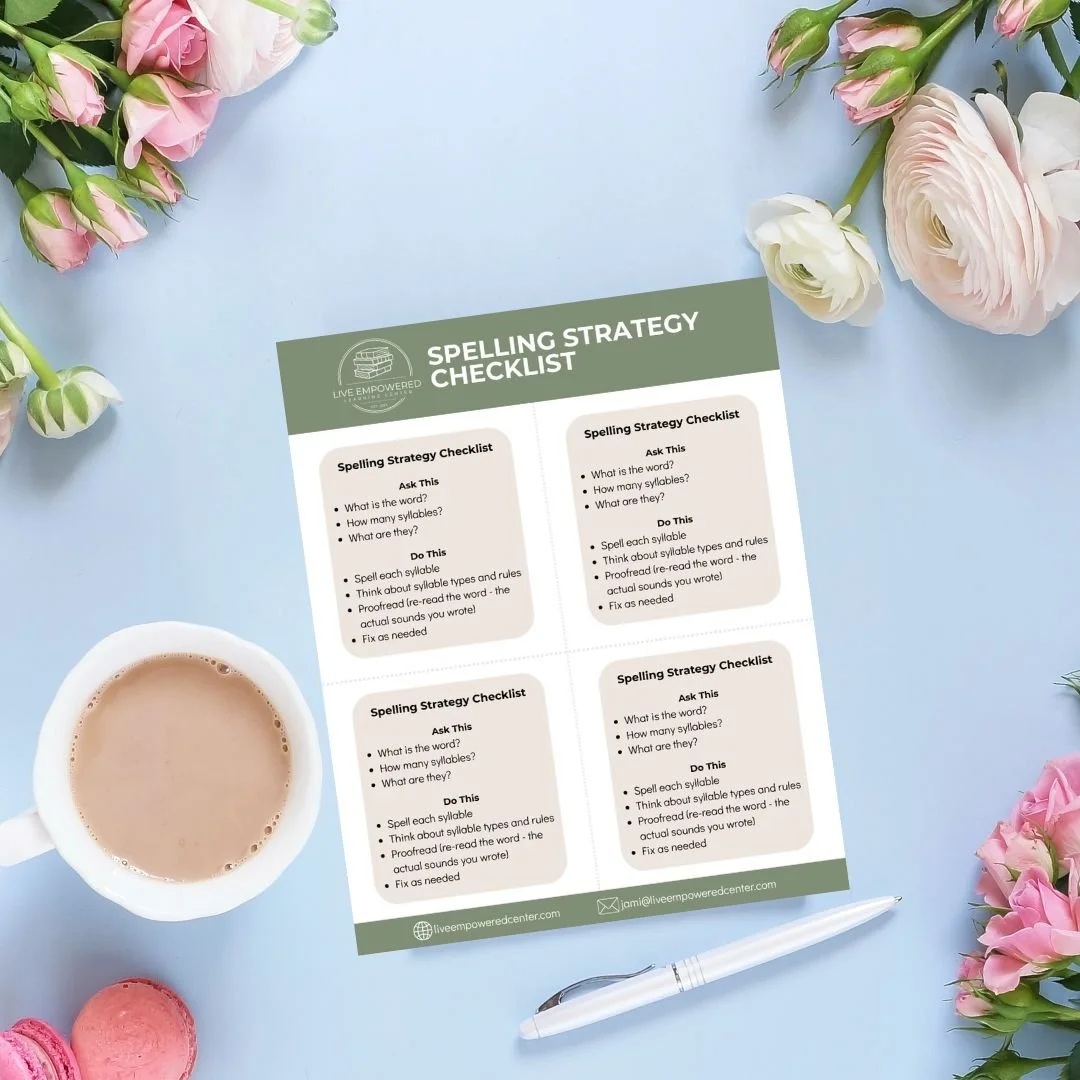
Spelling Strategy Checklist
What is the word?
How many syllables does it have?
Say the syllables out loud.
Spell each syllable.
Think about syllable types and spelling rules you know.
Proofread — re‑read the word exactly as written.
Fix as needed.
This checklist slows students down in a productive way and teaches them to engage their brains instead of guessing or relying on rote memory.
Why Syllables and Patterns Matter
Rather than asking students to memorize spelling lists, we explicitly teach:
The six syllable types
Common spelling generalizations
Meaningful patterns and word structures
This approach helps students understand why words are spelled the way they are. When children learn to break words into syllables and apply known rules and patterns, spelling becomes logical instead of overwhelming.
This is especially important for struggling readers—but it benefits all learners.
Spelling Tests vs. Real Spelling Skills
Here’s an important truth:
Doing well on spelling tests does not necessarily mean a child is a good speller.
Many students can memorize words for a short period of time, only to forget them days later. To truly understand a child’s spelling ability, we need to look at their independent writing.
Independent writing reveals:
Their natural thought patterns
The strategies they apply without prompts
How they problem‑solve when they’re unsure
This is where real spelling growth shows up.
Research‑Based Benefits for All Students
Strategy‑based instruction isn’t just helpful for struggling learners. Research consistently shows that explicit instruction in phonology, syllable types, and spelling patterns:
Improves word recognition and spelling accuracy
Strengthens reading fluency and comprehension
Supports higher‑achieving students by deepening word knowledge and vocabulary
When students understand how words work, they become more confident, flexible, and independent readers and writers.
Why These Strategies Matter for Teachers, Too
This spelling strategy checklist isn’t just helpful for parents supporting homework at home—it’s also a powerful instructional tool for teachers across grade levels, including upper elementary, middle school, and content-area classrooms.
When teachers guide students through a consistent spelling and word-analysis process, they are:
Teaching students how to approach unfamiliar academic vocabulary
Supporting decoding and spelling within science, social studies, and math content
Reinforcing transferable skills students can apply independently
In higher grades, students encounter longer, more complex, and often discipline-specific words. Breaking these words into syllables, identifying syllable types, and applying known spelling generalizations helps students access meaning rather than shutting down when words feel overwhelming.
Research-based literacy instruction shows that explicit teaching of word structure, syllables, and patterns:
Improves content-area reading comprehension
Supports written expression and spelling accuracy
Benefits both struggling learners and higher-achieving students by deepening vocabulary knowledge and metalinguistic awareness
Most importantly, this process-based approach gives teachers a clear framework for coaching students’ thinking, not just correcting their answers. It allows educators to ask better questions, provide targeted feedback, and help students become strategic, confident readers and writers across all subjects.
Focusing on What Matters Most
If your child struggles with spelling, know this: progress is happening—even when it’s not perfect yet.
By focusing on strategies, patterns, and thinking, we are building a strong foundation that will support your child far beyond a single spelling test.
The goal isn’t perfection today.
The goal is strong thinking that leads to lasting success.
