
Unpack your backpack.
Put your homework back in your bag.
Why are your shoes in the middle of the hallway?
Dishes in the dishwasher, please.
Brush your teeth.
Put your clothes away!
Sound familiar?
As parents, it can feel like we’re saying the same things a million times a day. We get exhausted. Our tone changes. We get frustrated. And if you’re anything like me, you end up yelling about something you never intended to yell about.
Then you see it. That look of frustration and disappointment on your kid’s face. And you remember: they aren’t actually trying to upset us on purpose.
What’s Really Going On: Executive Functioning
Executive functioning is the brain’s management system. It’s the set of skills that helps us plan, organize, start tasks, keep track of things, manage our time, control our impulses, and adjust when things don’t go as planned.
It’s built on three core skills:
Working memory: holding information in your mind while you use it (“I need my water bottle, my folder, and my shoes”)
Self-control: stopping to think before acting
Flexible thinking: shifting gears when plans change or a strategy isn’t working
The part of the brain that runs all of this, the prefrontal cortex, keeps developing into the mid-twenties. So when our kids forget the same things over and over, it isn’t laziness or defiance. It’s a brain that is still under construction.
Here’s the part that changed everything for me. When we give constant reminders, we become our child’s “brain manager.” It gets the shoes off the hallway floor, but it doesn’t help our kids build the skill. If we keep doing the thinking for them, they aren’t going to grow.
One Small Thing
Executive functioning is a struggle for ALL of our kiddos. (And let’s be honest, it can be for us busy adults too!) It can feel completely overwhelming. And when things feel overwhelming, the best place to start is with one small thing that’s manageable.
This summer I took the Feuerstein’s Instrumental Enrichment (FIE) training, and it changed how I see almost everything. FIE is built on the belief that intelligence isn’t fixed. Thinking can be taught and strengthened at any age. Learning about cognitive functions, and helping our students notice which ones they’re using, has changed the way I teach. And it has absolutely changed my parenting.
Here are two simple changes I’ve made at home and at the center with your kids.
Change #1: Systematic Search
Before we leave a room, we do a systematic search. We look through the room in an orderly way to make sure we have everything we need before we walk out.
Now here’s the key. If my kid says, “Yep, I have everything!” and I can see their water bottle sitting right there on the table, I don’t say, “Don’t forget your water bottle!”
I say, “Check again and let me know what else you see.”
That one small shift moves the mental load off of me and onto them. In FIE, we know that impulsive, unplanned searching is one of the biggest things that gets in the way of learning. Kids glance, guess, and move on. A systematic search teaches them to slow down, look in an organized way, and check their own work. That’s the same skill they need to find every error on a math page, catch the details in a reading passage, or make sure they’ve answered every part of a question.
Change #2: Raising Noticers
Mark Batterson’s Draw the Circle: The 40 Day Prayer Challenge is one I keep coming back to, and one day in particular has stayed with me. It’s called “First-Class Noticer.” Batterson points out that the most successful people are first-class noticers. They see what others miss. And prayer is what helps us notice what God wants us to see. As he puts it, “The more you pray, the more you notice.”
That idea has changed the way I see my days. It has opened my eyes to the people around me, the needs I would have walked right past, and the small ways God is working that I used to miss. Noticing isn’t something that just happens. It grows with practice. And after my FIE training, I realized even more that’s exactly how our kids learn to think, too.
I want my kids to be first-class noticers. And I want that for every one of our LELC kids.
Yes, I want them to notice the milk left out on the counter. But I want so much more than that. I want them to notice the classmate sitting alone at lunch who isn’t being included. I want them to look around and notice when something doesn’t feel safe. I want them to see when someone is struggling and ask, “How can I help?” I want them to walk into a room and see how they can serve.
That’s the heart behind everything we do. What we do in educational therapy and FIE, and what we do at home, isn’t just about a better grade or passing a test. It’s about building strong thinkers who are ready to be successful in life. The kind of people who notice, and who share the best of their gifts with a world that needs exactly who they were each created to be.
But it starts small. In our house, it starts in the kitchen.
When I walk into the kitchen and the milk is out with no lid and the cereal bowls are on the counter instead of in the dishwasher, I don’t launch into the list. I just calmly say, “Please come into the kitchen.”
They show up. “What???” (and if you have a pre-teen or teenager - this also comes with an eye roll and voice dripping with annoyance)
“Systematic search. Look around and see what needs to be taken care of.”
If they get part of it, I have them look again. If they leave and it’s not done, I ask them to come back. I’m doing way less telling. I’m asking questions, and I’m waiting until they notice it and figure it out.
Is it a little tiring at first? Yes. It does take some teaching up front about your expectations and how things should be done. Show them what “done” looks like a few times before you expect them to do it on their own. But they catch on faster and faster. And it helps you not lose your peace. (Which, in my house, is worth a lot!)
Questions Instead of Reminders
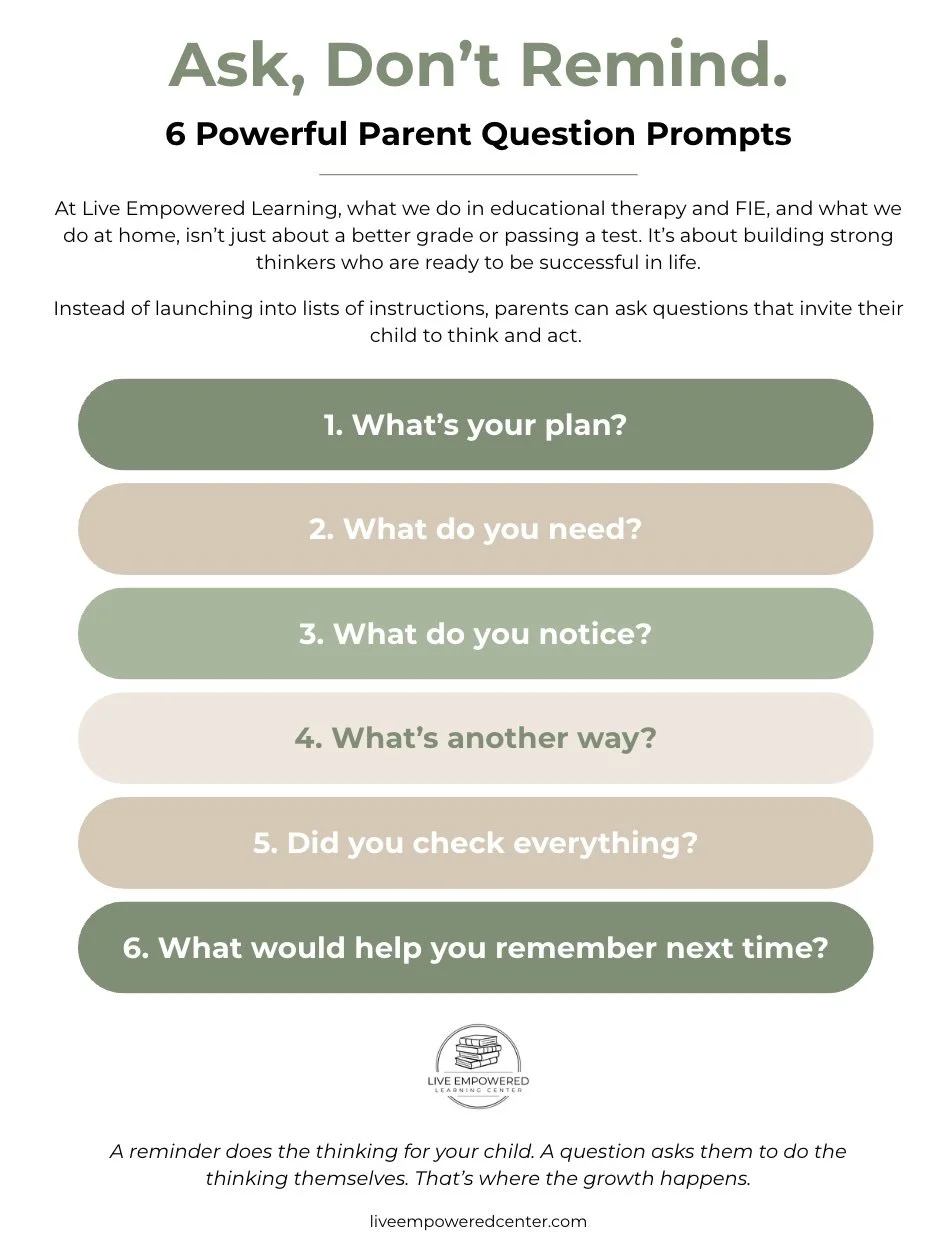
Below are a few questions I keep in my back pocket and that we’ve made into a printable to equip parents with question prompts. Feel free to print them and stick them on your fridge! You can print them by clicking here or by clicking on the image below. Remember, a reminder does the thinking for your child. A question asks them to do the thinking themselves. That’s where the growth happens.
Praise the Process (Even When It’s Messy)
This part is so important. When your child tries, notice it. Even when it isn’t super successful.
If they found the backpack but missed the lunchbox, celebrate the backpack! “You went back and checked on your own. That’s great thinking!” If they noticed the bowls but not the milk, start there. “You noticed the bowls! Now what else do you see?”
When we praise the effort and the thinking, not just the finished result, kids learn that their brains are growing. And they want to keep trying.
Why We Know This Works
This is exactly what we do in our educational therapy and FIE sessions with your kids. We don’t tell. We ask questions to guide them to the answer. We ask them to be noticers. And they always rise to the occasion.
Do they forget sometimes? Yes.
Do they still need reminders? Yes.
Is their thinking growing stronger? YES.
Grace, Grace, and More Grace
Friends, please give yourselves grace. And give it to each other too. Executive functioning gets harder for ALL of us when we’re tired, stressed, hungry, or off our normal routines. (Hello, holiday season!) So on the hard days, it’s okay to keep it simple.
You are going to forget to ask instead of tell. You’re going to lose your patience some days. (Me too! Just ask my kids.) Your kids will forget, and they’ll need reminders. That’s okay. We are all learning together. Growth isn’t about getting it perfect. It’s about showing up and trying again. That goes for our kids, and it goes for us.
So pick one small thing this month. Maybe it’s leaving for school. Maybe it’s cleaning up after dinner. Try asking instead of telling, and watch your kids rise to the occasion.
